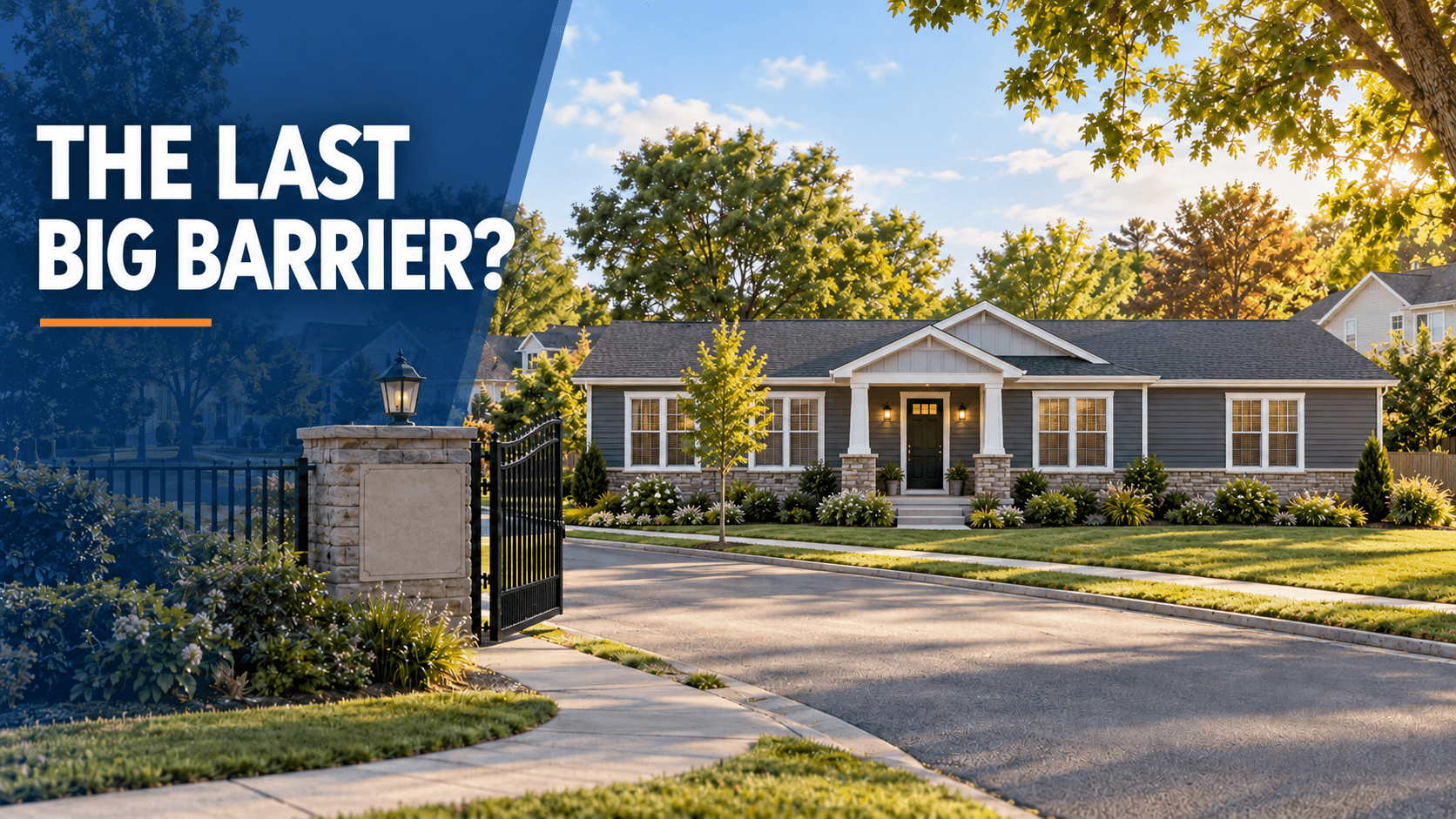
Is Manufactured Housing’s Last Big Barrier About to Crumble?
For decades, the manufactured housing industry has faced a frustrating contradiction.
America needs affordable housing. Manufactured homes can provide quality housing at prices many families can afford. Yet in communities across the country, local zoning regulations make it difficult—or sometimes impossible—to place a manufactured home in neighborhoods where other single-family homes are permitted.
Now that may finally be changing.
Washington has begun removing federal barriers to manufactured housing. The 21st Century ROAD to Housing Act, signed into law in July, contains significant reforms intended to encourage manufactured housing and increase the nation’s housing supply. HUD has also recommended that state and local regulators reconsider restrictions that treat manufactured and modular construction differently from comparable site-built housing.
But removing federal barriers only gets us so far.
If manufactured housing is going to play a larger role in solving America’s housing shortage, the next battle may be fought not in Washington, but in state legislatures, county courthouses and city halls.
A Home You Can Build—but Can’t Place
Manufactured housing has changed dramatically since the HUD Code took effect in 1976.
Today’s homes can feature residential roof pitches, porches, garages, drywall interiors, large kitchens, luxury bathrooms and architectural details virtually indistinguishable from site-built homes.
Yet zoning regulations in many communities continue to focus on how the home was constructed rather than the quality of the finished home.
HUD itself has now called attention to this issue. Its 2026 State and Local Best Practices for Home Construction specifically recommends that governments regulate manufactured and modular homes using objective building and safety standards rather than their construction method. HUD also recommends reconsidering prohibitions on manufactured housing when comparable site-built homes are permitted.
That represents a potentially significant change in the conversation.
Instead of asking, “Was this home built in a factory?” policymakers may increasingly be asked:
“Does this home meet appropriate standards for this neighborhood?”
Those are two very different questions.
Kentucky Offers a Glimpse of What Could Be Coming
Kentucky recently took that idea much further.
House Bill 160, which became effective July 1, 2026, prohibits local governments from excluding a “qualified manufactured home” from residential zones where single-family homes are permitted. The law also prevents local zoning regulations from discriminating against qualified manufactured homes.
That doesn’t mean anything can be placed anywhere.
Kentucky’s law establishes requirements involving the home’s age, size, permanent foundation and installation. Local governments can still impose certain compatibility standards involving such things as roof pitch, exterior materials, setbacks, lot dimensions and orientation—but architectural requirements applied to manufactured homes cannot be more stringent than those applied to other single-family homes in the same zone.
In other words, communities retain significant control over what housing looks like, while having less ability to discriminate simply because of where or how the housing was built.
That distinction could become an important model for other states.
Local Control Meets a National Housing Shortage
There is another side to this debate.
Local zoning authority exists for legitimate reasons. Communities have an interest in land-use planning, infrastructure, neighborhood character and property values. Kentucky’s law itself expressly recognizes the legitimate role of local governments in protecting property values.
But those interests are increasingly colliding with a much larger problem: America isn’t building enough housing.
The new federal housing law attempts to encourage greater housing production partly by supporting states and localities that modernize zoning, permitting and other housing policies. Recent analysis of the law notes that many of its potential benefits now depend on what state and local governments do next.
That puts manufactured housing directly in the middle of one of America’s most important housing-policy debates.
The Industry Has Work to Do, Too
Changing zoning laws won’t automatically change public perception.
Manufacturers, retailers and developers need to give local officials compelling examples of what modern manufactured housing actually looks like. The Innovative Housing Showcase, held for the past several years in Washington, DC has been able to accomplish that on the federal level. The message needs to now permeate down to the local level.
Imagine walking into a planning commission meeting armed not simply with arguments about affordability, but photographs of attractive developments, architectural renderings, comparable property values and examples of manufactured homes already integrated successfully into conventional neighborhoods.
The industry’s argument becomes much stronger when the conversation shifts from defending “manufactured housing” as a category to demonstrating the quality of the actual homes being proposed.
That may be especially important as manufacturers gain greater design flexibility under recent federal reforms.
The Next Barrier Is Closer to Home
For years, much of the manufactured housing industry’s attention has been directed toward Washington.
That made sense. Federal construction regulations, financing rules and other policies significantly influence the industry.
But Washington is beginning to move.
Kentucky is demonstrating what state-level reform can look like. HUD is encouraging local governments to reconsider regulations that unnecessarily restrict factory-built housing. And the country’s continuing housing shortage is putting increasing pressure on policymakers to find ways to increase supply.
At Manufacturedhomes.com, we’ve already begun to take that message to the public by means of videos, photography, case studies, and customer testimonials that feature manufactured homes that are virtually indistinguishable from site-built construction. We feature these on the websites we build for our retail clients as well as those we host for state associations. They are making a difference, breaking down barriers.
We know how to build affordable homes.
Now it’s up to us as an industry to convince local governments that these are homes they want and need in their communities.
Our next great opportunity is upon us. Are we up to the challenge?