BoulderMOD: The Idea, The Actions, The Results, and the Future
Communities across the country are wrestling with the same question: how do we create permanently affordable housing in markets where land is scarce, costs are high, and growth is tightly controlled?
Boulder, Colorado didn’t just ask the question. They built an answer. BoulderMOD is not simply a modular housing factory. It is the product of vision, leadership, collaboration, and long-term commitment. It represents what can happen when a city chooses not to react to housing challenges, but to engineer a solution.
The origin of BoulderMOD traces back to the 2013 floods that severely impacted the Ponderosa mobile home park in North Boulder. While the elevated homes themselves fared relatively well, the infrastructure, roads, utilities, and site conditions, suffered extensive damage. The private owner lacked the capacity to rehabilitate the community, and the City of Boulder stepped in to purchase it.
But the city’s goal was not displacement. It was stabilization. City leadership, particularly Housing Director Kurt Firnhaber, made a commitment: no resident would be forced out. At the same time, it was clear that many of the pre-1976 homes in Ponderosa were aging and needed replacement.
Rather than rely solely on traditional construction methods, the city began exploring factory built housing. A visit to Vermont to study an existing modular facility sparked a realization: if other communities could build housing in a factory environment, Boulder could too. Then came the natural partnership.
Firnhaber had previously worked both with Habitat for Humanity and the Boulder Valley School District’s construction trades program. He saw something others had not yet connected, housing production, workforce development, and community stabilization could happen under one roof. That vision became BoulderMOD.
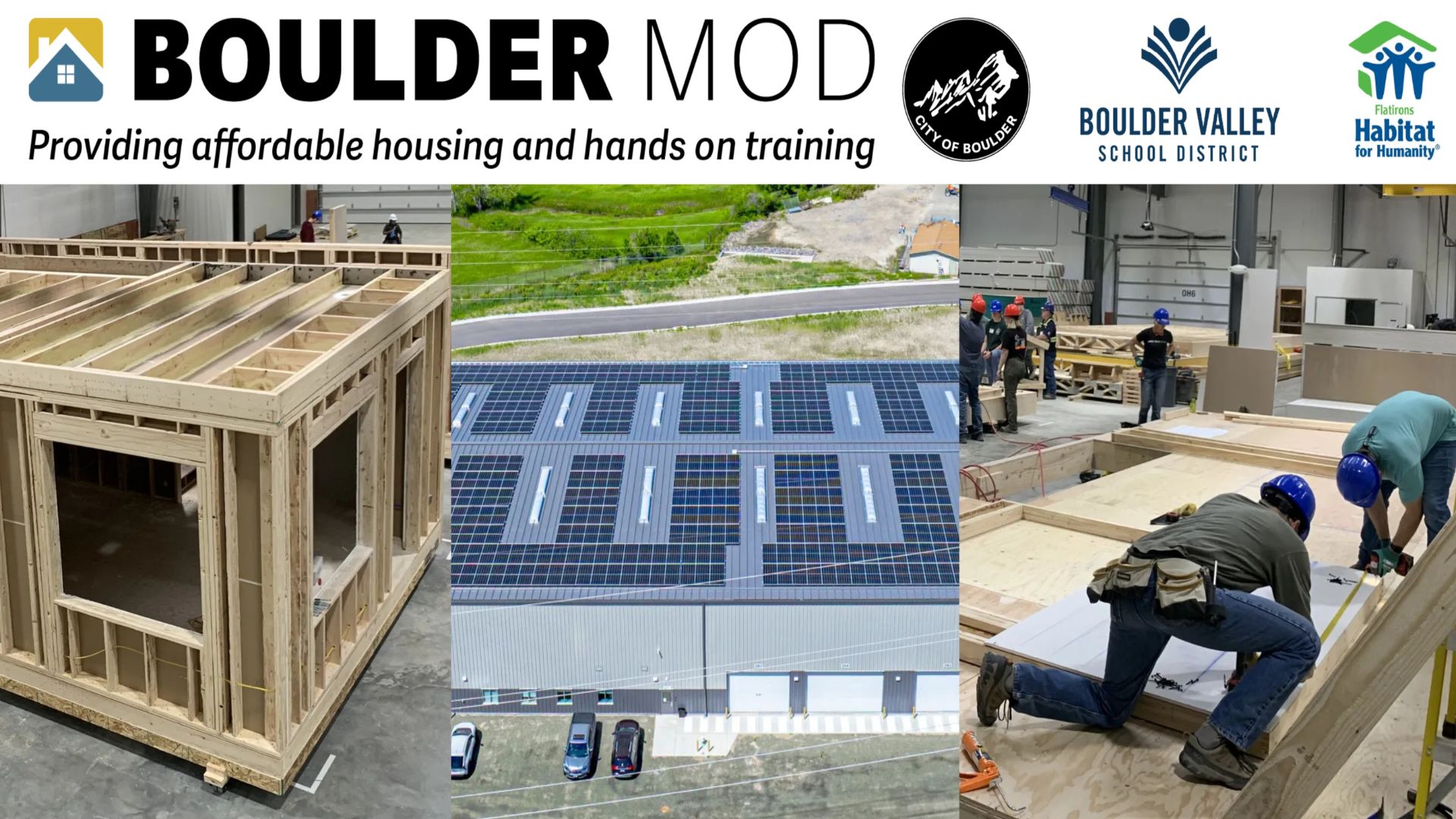
Turning vision into reality required five years of work. The City of Boulder raised capital through grants, loans, and local funding. They secured land adjacent to the school district’s construction trades program, land that had previously housed the district’s bus fleet. The proximity was intentional: students could walk directly from classroom to factory floor.
Habitat for Humanity was selected to operate the factory. While Habitat had historically built one or two homes per year, BoulderMOD offered the opportunity to dramatically expand production capacity.
The facility was constructed, certified under IRC code (not HUD code), and designed to produce fixed-foundation duplex homes. The standard model is approximately 1,150 square feet per unit, three bedrooms, one and a half baths. Homes are craned into place and installed within existing infill sites, initially within Ponderosa, replacing older manufactured homes while preserving community layout.
The city structured financing to protect affordability:
- Residents who owned their existing mobile homes may receive compensation to use as down payment on a new one.
- Buyers secure traditional first mortgages when possible.
- The city fills affordability gaps with silent second mortgages.
- Homes are permanently affordable through deed restrictions.
- Units are priced based on Area Median Income (typically 60% AMI in Ponderosa), even though construction costs exceed sales price.
In its first year of operation, BoulderMOD completed its initial homes and is now producing approximately one home per month, with a goal of 15–20 annually and an eventual target of 25–30 units per year. But the numbers tell only part of the story.
Community Stability Without Displacement
Residents were given the choice to remain indefinitely in their existing homes or transition into new duplex units. Many have chosen to move into modern, energy-efficient homes. The city honored its promise, with no forced displacement.
Workforce Development in Action
What began as a housing initiative quickly became a powerful educational tool. The Boulder Valley School District construction trades program expanded from 15 students to 40, with more growth anticipated. Students are not building mock projects. They are constructing real homes for real families. Enthusiasm has exceeded expectations, and student contributions have been stronger than anticipated. Summers and school breaks are supplemented with Habitat’s successful, experienced volunteer labor model.
A Model Drawing National and International Attention
Other municipalities are calling weekly to learn from Boulder’s experience. Delegations, even from Japan, have visited the facility. The concept resonates: local government leadership + nonprofit housing expertise + public education partnership + factory-built housing.
Sustainability Built In
The facility operates with support from a substantial solar array (rooftop), lowering operational costs and reinforcing Boulder’s climate goals. Environmental responsibility and housing affordability are not competing priorities here, they reinforce each other.
BoulderMOD was never intended as a short-term experiment. The goal is long-term production serving Boulder County, with expansion possible as pipeline sites are entitled and foundations prepared. Lessons learned include the importance of maintaining a steady development pipeline to avoid factory slowdowns.
The city also sees modular housing as a tool to help developers meet annexation requirements by incorporating permanently affordable units. Habitat may complete modular units on developer-provided foundations, offering a cost-effective compliance solution.
The emphasis going forward remains:
- Permanent affordability
- Increased production capacity
- Workforce pipeline development
- Operational efficiency
- Strong leadership continuity
As Jay Sugnet of the City of Boulder put it plainly: “I didn’t spend five years building this thing for it to end.”
BoulderMOD is not the cheapest way to build housing. Boulder is an expensive market, and subsidy is required. But cost savings alone were never the sole objective. The true innovation lies in:
- Combining education and housing production
- Replacing aging manufactured housing without displacement
- Creating permanently affordable home ownership
- Leveraging factory efficiency for predictable quality
- Aligning sustainability with affordability
- Demonstrating municipal leadership in action
As manufactured and modular housing continues gaining national attention as part of the affordability solution, BoulderMOD offers a blueprint for municipalities willing to think beyond conventional models.
This extensive work in BoulderMOD had similar intentions of the Perry Central High School modular build in Tell City, Indiana, documented in 10 episodes by ManfacturedHomes.com, in which they both developed a partnership with Habitat for Humanity. Both demonstrate that modular housing can be much more than a construction method; it can be a community catalyst. In Boulder, municipal leadership, education, and nonprofit collaboration produced a factory that builds permanently affordable homes while training the next generation of skilled workers. In Tell City, students brought that same principle to life on a local scale, constructing a modular home that not only teaches real-world skills but directly contributes to affordable housing stock with Habitat’s support. Both initiatives show how modular construction can unify education, affordability, workforce development, and community empowerment, turning innovative concepts into tangible homes and, ultimately, stronger, more resilient communities. As these projects continue to inspire and expand, they illuminate a path for other cities and towns eager to address housing challenges with creativity, collaboration, and purpose.
This is not theory. It is operational. It is measurable. And it is replicable, if leadership, staff capacity, and long-term commitment are present.
Stronger vision builds stronger systems – Stronger systems build stronger communities.
Information:
BoulderMod:
https://bouldercolorado.gov/projects/boulder-mod
Perry Central HS building a MOD home and siting it in Tell City, IN, with Habitat for Humanity:
Episode 10: https://www.youtube.com/watch?v=NcgFCU91TFs
Episode 9: https://www.youtube.com/watch?v=n9_Va0_Tt0Y&t=38s
Episode 8: https://www.youtube.com/watch?v=aRPiowhh9iw&t=7s
Episode 7: https://www.youtube.com/watch?v=6dOjgj8G0mw
Episode 6: https://www.youtube.com/watch?v=i-mwPQuAxX4
Episode 5: https://www.youtube.com/watch?v=WX1DgfErNVs
Episode 4: https://www.youtube.com/watch?v=omnzUtEBgRQ&t=35s
Episode 3: https://www.youtube.com/watch?v=2hWf2mftrOw&t=291s
Episode 2: https://www.youtube.com/watch?v=8-aow3ZqlYk&t=4s
Episode 1: https://www.youtube.com/watch?v=DddYn3Y30jI